
Online course
Darbuka Mastery
Play the darbuka with confidence. 32 lessons, 8 rhythms, 42 play-along tracks, and a relaxed, tension-free technique from April Centrone. Lifetime access.
Watch the intro
Made for
Complete beginners
You have a drum, or you are about to get one, and you want to play real rhythms with relaxed, healthy technique.
Self-taught players
You can play something, but your technique is a mystery to you. Every stroke here has a name and a drill.
Dancers and musicians
You want to understand the rhythms you already move to or play with.
What you will learn
Module 1: Warm-up, stretching and posture
Module 2: Dominant-hand strokes: doum, tak and slap
Module 3: Alternate-hand strokes: ka and pop
Module 4: Essential combinations, with play-along tracks at three tempos
Module 5: Eight popular rhythms: maqsoum, baladi, saidi, roumba, malfouf, ayyoub, karachi and fellahi
Plus a 30-day practice plan and a notation and rhythm reference to download.
A technique your hands can keep for life
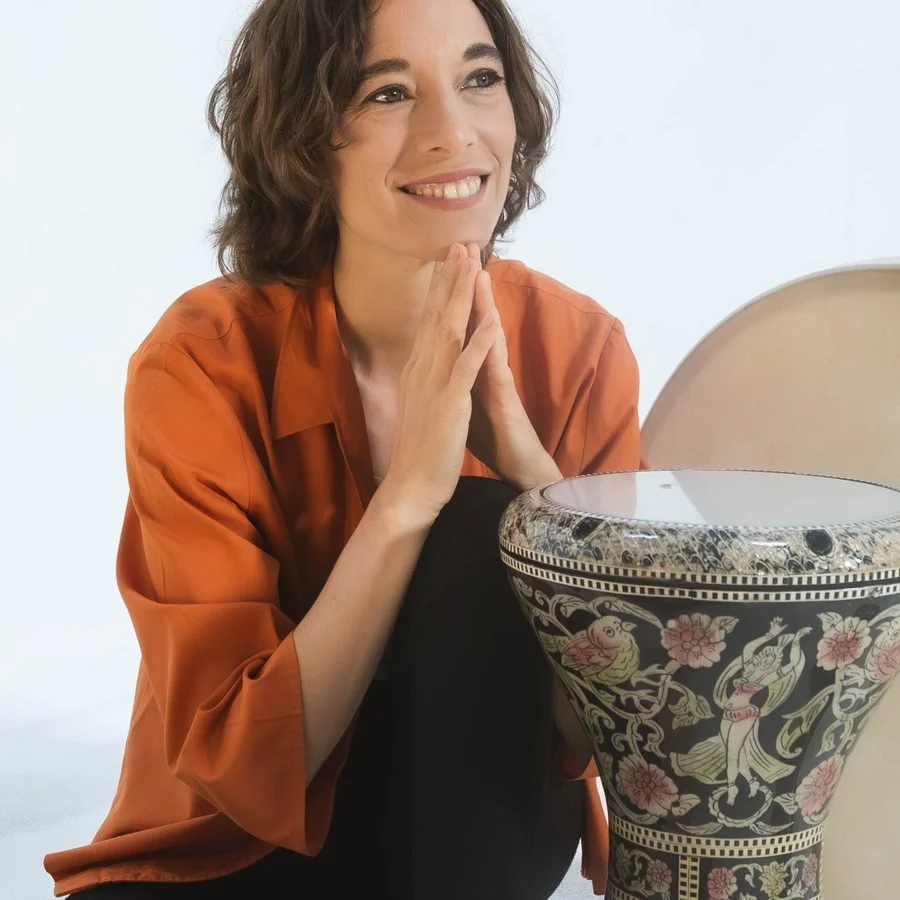
Playing drums is mostly unlearning tension: learning to play powerfully with the least effort by using your human spring, the system of joints that runs through your whole body. My method brings together more than two decades of classical Arabic training, from performing with legends like Ziad Rahbani and Marcel Khalife to studying with Simon Shaheen, Bassam Saba and Michel Merhej Baklouk, so you sound authentic whether you play with a takht or an orchestra. It also draws on my work in Arabic and fusion pop and on festival stages from Coachella to Jazz in Marciac, and on two decades of health practice for musicians, from physical therapy movements and qi gong to yogic stretching and breathing.
April Centrone
What students say
“I had April as a Darbukkah instructor and I enjoyed every single class I took with her. She is very patient with students with different levels and has a way of making everybody in the group feel an important part of it and more importantly pushes each one of the group members a bit further each class. She is also very knowledgeable about music theory in general. It was a pleasure studying with her.”
Tala Farran
“April was my first Middle Eastern percussion teacher, and studying the frame drum with her over many years was a transformative experience. Her lessons helped launch my journey and ignite my musical curiosity. I’m grateful for the dynamic, welcoming, and inspiring learning environment she created. April is a gifted percussionist, and I hope that anyone who chooses to study with her will also appreciate her skillful and valuable approach to playing the drum. Thank you, April, for your trust, your support, and for encouraging growth and exploration!”
Kriss Zambrano
“I found April Centrone’s page on IG and was immediately drawn to her percussion videos. When I saw she was offering workshops, I signed up for her Darbuka basics! In one hour and thirty minutes, we learned basic strokes, five popular rhythms and about their variations and even covered some music theory! April was clear with her instructions, she took our questions and gave us a chance to practice. I highly recommend April’s classes and workshops to anyone interested in learning percussion.”
Manar Harb
One price. Lifetime access.
$197, or 3 monthly payments of $69. Every lesson, every play-along track and both PDF guides, yours to rewatch any time.
Lifetime access to the Darbuka Mastery online course: 32 lessons, 8 rhythms, 42 play-along tracks, and two PDF guides.
Questions
Do I need a darbuka before I start?
Yes. Have your drum before you start; you will get the best results. If you need one, Sala Muzik in Los Angeles carries a wide range of good darbukas at fair prices, and April’s students get a discount at salamuzik.com/APRILCENTRONEPAGE or with the code APRILCENTRONEPAGE. April earns a small commission on these sales.
Is this for complete beginners?
Yes. It starts before your first stroke, with how to sit, hold the drum and relax your hands, then builds one stroke at a time.
I already play a little. Will I learn anything new?
Most likely. Every stroke is broken down into named positions and drills, and the rhythm lessons add ornaments, rolls and accents on top of the basic patterns.
How long do I have access?
For life. Buy once and rewatch any lesson whenever you like.
How is this different from free YouTube lessons?
It is a complete path in the right order: 32 lessons from warm-up to eight full rhythms, 42 play-along tracks at three tempos, a 30-day practice plan, and a technique built around relaxed, tension-free playing.
How much time do I need each day?
About 20 to 30 minutes a day, warm-up included. The 30-day practice plan in the course tells you exactly what to practice each day.
Can I ask questions along the way?
The course has no built-in Q&A. You can email info@acearts.org, and if you want regular feedback on your playing, the live Zoom classes are the next step.
Darbuka Mastery
Every lesson in the course. The welcome lesson is free to watch; the rest unlock when you buy.
-
-
-
The human spring, and why loose joints play bigger, faster and louder.
-
The first stretch: the sides of the wrists.
-
Front wrist stretch, wrist circles and shoulder rolls
The rest of your warm-up: wrists, circles and shoulders.
The rest of your warm-up: wrists, circles and shoulders.
-
How to sit and hold the drum so it balances on its own.
-
Wrist exercise: letting go of tension
Why 90 percent of playing is in the wrists, and how daily tension gets in the way.
Why 90 percent of playing is in the wrists, and how daily tension gets in the way.
-
A simple test that tells you when your hands are relaxed enough to play.
-
-
-
Introduction to the dominant-hand strokes
Doum, tak and slap: the strokes that carry the core rhythm.
Doum, tak and slap: the strokes that carry the core rhythm.
-
The low, open bass tone, played from the elbow.
-
The rim stroke, played from the wrist like a door hinge.
-
The heavy stroke, played from the elbow with a cupped hand.
-
-
-
Introduction to the alternate-hand strokes
Ka and pop, played from the wrist, and two ways to play ka.
Ka and pop, played from the wrist, and two ways to play ka.
-
The alternate-hand high tone, with the ring-finger and split-finger techniques.
-
Pop is a ka with a changed pitch. Learn it, then alternate the two.
-
A simple drill if the ka motion isn't clicking yet.
-
-
-
Introduction to the combinations
Fourteen exercises that build the bridge from single strokes to full rhythms.
Fourteen exercises that build the bridge from single strokes to full rhythms.
-
Join the elbow motion of doum to the wrist motion of tak.
-
Two elbow strokes: the bounce of doum and the weight of slap.
-
Both hands together: one wrist open while the other is closed.
-
Three strokes and the most important habit: preparation.
-
4E: Doum, slap, ka and tak
Seven exercises with all four strokes, the last step before full rhythms.
Seven exercises with all four strokes, the last step before full rhythms.
-
-
-
How the rhythm play-alongs work, and how to move up through the tempos.
-
The most common rhythm in Egyptian music.
-
The heavy, grounded rhythm of Egyptian folk and popular music.
-
The rhythm of Upper Egypt, with its two doums in the middle of the bar.
-
The Latin rhythm that bridges Arabic and Spanish music.
-
A fast, driving 2/4 rhythm for entrances and transitions.
-
A hypnotic 2/4 rhythm with roots in trance music.
-
Ayyoub turned upside down: a popular 2/4 rhythm that starts on tak.
-
The quick, lively rhythm of the Egyptian countryside.
-
-
Start today
Lifetime access for $197, or 3 monthly payments of $69. Not sure yet? Try the free lesson first.